Building the Business Case for AI Maintenance: A CFO-Ready Framework
A step-by-step template for calculating predictive maintenance ROI, with specific formulas and benchmarks that plant managers and CFOs actually trust.
You spent six months building a case for predictive maintenance software. You had the vendor quotes, the pilot plan, the sensor specifications, and a 14-slide deck full of PF curves and MTBF projections. Then the CFO looked at it for four minutes, asked "What's the payback period?", and moved on to the next capital request.
I've watched this happen more times than I can count. The technology isn't the problem. The financial framing is. Most maintenance proposals die not because the ROI isn't there, but because the person writing the proposal speaks engineering and the person approving the budget speaks finance. Those are two different languages, and the translation gap kills good projects every quarter.
This article gives you a repeatable framework for building a business case that finance teams actually approve. Not theory. Specific formulas, real numbers, and a one-page template you can fill out this week.
Why 68% of Maintenance Software Proposals Die in Finance
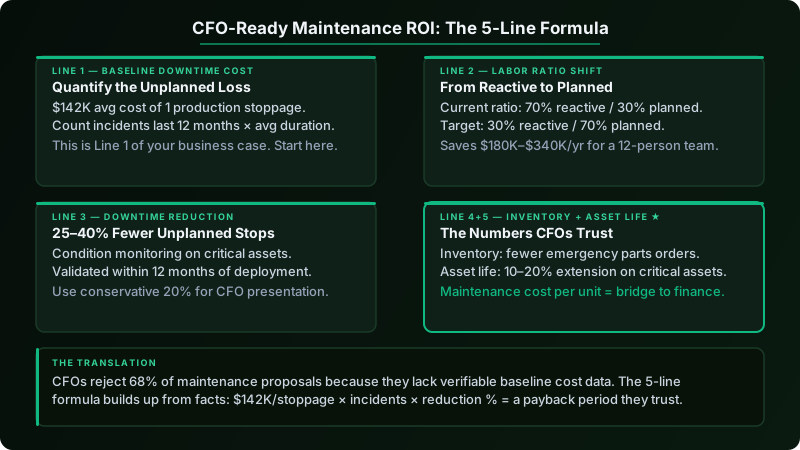
A 2023 survey by Plant Engineering found that 68% of maintenance technology proposals are rejected or deferred at the finance approval stage. The top reason wasn't cost. It was "insufficient baseline data to validate projected savings." In plain terms: the maintenance team couldn't prove what the current problem was costing, so finance couldn't trust what the solution would save.
Here's what most proposals get wrong. They lead with vendor features. "The platform uses machine learning to detect anomalies across 14 failure modes." That's interesting to an engineer. To a CFO, it's noise. CFOs evaluate maintenance software the same way they evaluate a new production line, a warehouse expansion, or a fleet upgrade. They want to see net present value, payback period, and internal rate of return. If you don't speak that language, your proposal competes poorly against capital projects that do.
The second mistake is assuming the CFO understands engineering terminology. MTBF, OEE, PF interval, condition-based monitoring. These are precise, useful terms inside the maintenance department. Outside of it, they're jargon. When you present a "37% improvement in MTBF," the CFO hears a number without a dollar sign. That's a number they can't use.
The fix is a four-step process: establish your cost baseline, calculate avoidance value in financial terms, frame the proposal as a pilot with clear payback triggers, and pre-answer the objections that will come up. The rest of this article walks through each step with specific numbers.
Process Overview
Calculating Your True Maintenance Cost Baseline
Before you can project savings, you need to prove what the problem costs today. This is where most business cases fall apart. Plant managers estimate downtime costs from memory instead of pulling verified data, and finance teams reject estimates they can't trace back to source records.
Start by pulling 12 to 24 months of work order data from your CMMS. Whether you're on SAP PM, Maximo, Fiix, or eMaint, you need four data sets: unplanned downtime events (with duration and affected production lines), reactive labor hours (including overtime, weekend callouts, and contractor charges), spare parts purchases flagged as emergency or expedited, and secondary damage records where one failure caused another.
The Four Cost Buckets
Unplanned downtime is usually the largest bucket. Calculate it as: (production rate in units per hour) × (margin per unit) × (total unplanned downtime hours). For a bottling line running 600 units per minute at $0.12 margin per unit, one hour of unplanned downtime costs $4,320 in lost margin alone. That doesn't include restart waste, quality losses, or missed delivery penalties.
Reactive labor costs are sneaky because they hide inside your regular payroll. Pull every work order classified as "emergency" or "breakdown" and total the labor hours. Then apply your fully loaded labor rate, including overtime premiums. Most plants discover that 15-25% of total maintenance labor hours are reactive overtime.
Spare parts expediting adds 30-60% to part costs. When a bearing fails unexpectedly, you're not ordering from your usual distributor at contract pricing. You're paying overnight freight and accepting whatever the nearest supplier has in stock. Pull your purchase orders for the last 12 months and flag anything with expedited shipping or non-contract pricing.
Secondary damage is the hardest to quantify and the easiest to underestimate. When a gearbox seizes because a bearing wasn't replaced in time, you're not just replacing the bearing. You're replacing the gearbox, the shaft, and possibly the coupling. I worked with a mid-size bottling plant in Ohio that traced $1.7M in annual maintenance spend to secondary damage from just six failure events. Their CMMS had the data. Nobody had connected the dots until they built the cost baseline.
Build a simple spreadsheet with four columns: cost bucket, data source, 12-month total, and cost per unplanned event. This becomes your "current state" evidence, the single most important page in your business case.
The 5-Line ROI Formula That Finance Understands
Once you have your baseline, calculating projected ROI is straightforward. I use a five-line formula because it covers the major value categories without overwhelming the reader. Each line maps directly to a cost bucket your CFO already tracks.
Line 1: Downtime Avoidance. Take your total unplanned downtime hours from the baseline, multiply by the reduction percentage you're projecting (conservative: 25%, expected: 40%, optimistic: 55%), and multiply by your cost per unplanned hour. If you had 480 unplanned hours last year at $4,320 per hour, a 40% reduction saves $829,440.
Line 2: Labor Efficiency. Most reactive-heavy plants run a 70/30 split (reactive/planned). Predictive maintenance flips that toward 30/70 over 18 to 24 months. Calculate the cost difference: fewer overtime hours, fewer weekend callouts, fewer contractor emergency rates. A typical plant with 12 maintenance technicians saves $180,000 to $340,000 annually on this line alone.
Line 3: Inventory Reduction. With better failure prediction, you carry less emergency safety stock and order fewer expedited parts. Typical inventory carrying cost is 20-25% of inventory value annually. If your spare parts inventory is $800,000 and you can reduce it by 15%, that's $24,000 to $30,000 in annual carrying cost savings, plus the one-time cash release from the inventory reduction itself.
Line 4: Energy Savings. Equipment running outside its optimal parameters consumes more energy. Misaligned motors, degraded bearings, fouled heat exchangers. Studies from the U.S. Department of Energy show that condition-based maintenance delivers 3-8% energy savings on monitored equipment. On a $2M annual energy bill, even 3% is $60,000.
Line 5: Asset Life Extension. This is the line that gets CFOs' attention. If predictive maintenance allows you to defer a $1.2M compressor replacement by three years, the net present value of that deferral at a 10% discount rate is approximately $300,000. Capital avoidance is real money, and finance teams understand it immediately.
Key Statistics
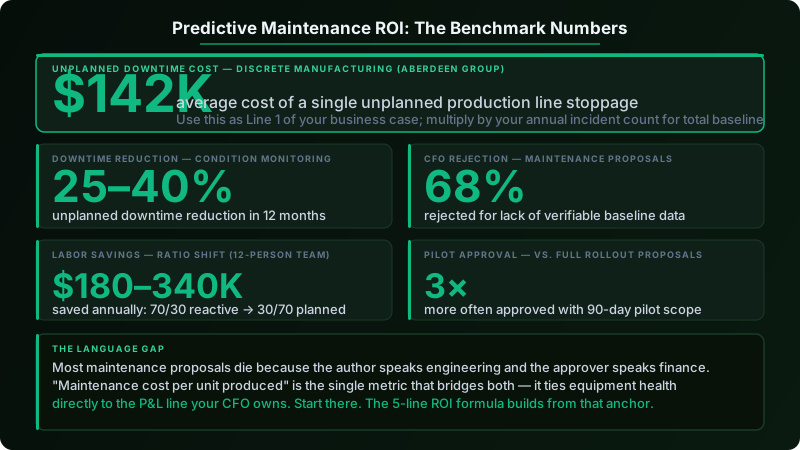
$142K
Average cost of a single unplanned production line stoppage in discrete manufacturing (Aberdeen Group)
25-40%
Typical reduction in unplanned downtime within 12 months of deploying condition monitoring on critical assets
70/30 → 30/70
The reactive-to-planned maintenance ratio shift that saves $180K-$340K annually for a 12-person team
3-8%
Energy savings on monitored equipment from maintaining optimal operating parameters (U.S. DOE)
Key Metrics
Translating Engineering Metrics into CFO Language
The single biggest unlock in building a maintenance business case is learning to express engineering outcomes in financial terms. Not because engineering metrics are less valid, but because the person signing the check uses a different scoreboard.
MTBF becomes revenue protected per quarter. If your MTBF on a critical pump improves from 90 days to 150 days, that means fewer failure events per year. Multiply the avoided events by your cost per event, and you have a dollar figure. "We project protecting $412,000 in quarterly revenue by reducing critical pump failures from 4 per year to 2.4."
OEE gains translate to units produced per dollar of maintenance spend. If your OEE increases from 72% to 78% and your annual maintenance budget is $3.2M, you're producing 8.3% more output per maintenance dollar. That ratio is something a CFO can compare across facilities and benchmark against industry standards.
Predictive maintenance accuracy works as insurance math. The annual software and sensor cost is your "premium." The probability-weighted cost avoidance is your "coverage." If your PdM system has 85% detection accuracy across 20 potential failure events averaging $142K each, the expected annual avoided loss is $2.41M. Against a $120K annual platform cost, that's a 20:1 benefit ratio. Frame it this way and the CFO sees it as risk management, not a technology purchase.
The bridge metric that ties everything together is maintenance cost per unit produced. It's the one number both engineering and finance trust because it connects maintenance spending directly to production output. Track it monthly. Report it quarterly. It's the metric that makes your business case self-reinforcing over time.
| Engineering KPI | Financial Equivalent | Example Translation | Why Finance Cares |
|---|---|---|---|
| MTBF (Mean Time Between Failures) | Revenue protected per quarter | 90-day to 150-day MTBF = $412K/quarter protected | Direct revenue impact |
| OEE (Overall Equipment Effectiveness) | Units per maintenance dollar | 72% to 78% OEE = 8.3% more output per $1 spent | Capital efficiency |
| PdM Detection Accuracy | Probability-weighted cost avoidance | 85% accuracy × 20 events × $142K = $2.41M avoided | Risk reduction |
| Planned vs. Reactive Ratio | Overtime and contractor cost delta | 70/30 to 30/70 = $260K annual labor savings | Controllable cost |
| Remaining Useful Life (RUL) | Capital deferral NPV | 3-year deferral on $1.2M asset = $300K NPV | Cash flow timing |
The Pilot-First Proposal: How to Get a Yes in 30 Days
Full plant-wide PdM rollouts cost $200K to $500K and require 6 to 12 months of implementation. Proposals at that scale trigger capital approval committees, board reviews, and competing priority debates. Most of them stall.
Pilot proposals get approved 3x more often. Here's why: they stay below capital expenditure thresholds (typically $50K at most mid-size manufacturers), they deliver proof points within 90 days, and they give finance a contained risk. If the pilot fails, you've spent $25K, not $350K.
How to Structure the Pilot
Select 3 to 5 critical assets. The right assets have three characteristics: high downtime cost (top 10 in your baseline analysis), existing sensor infrastructure or easy retrofit (vibration, temperature, current), and known, recurring failure modes documented in your CMMS.
Budget the pilot between $15K and $40K. That covers wireless vibration and temperature sensors ($200 to $800 per point for industrial-grade units from vendors like Fluke, SKF, or Petasense), platform subscription for the monitoring period, and basic CMMS integration via API for automated alert routing.
Define success criteria in financial terms before the pilot starts. "One prevented failure event on any monitored asset during the 90-day pilot period" is a clear, measurable bar. If your average failure cost on the selected assets is $85K or higher, a single catch pays back the entire pilot investment.
Build expansion triggers into the proposal. "If the pilot detects and prevents at least one failure event, Phase 2 budget of $X is pre-approved for the next asset group." This removes the need to go back through the approval process. The CFO makes one decision, not two.
The Approval Shortcut Most Engineers Miss
Keep your pilot budget below your facility's capital expenditure threshold. At most mid-size manufacturers, projects under $50K can be approved by the plant manager or VP Operations without going to the capital committee. Ask your plant controller what that number is. Then design your pilot to come in 20% under it.
Risk Objections CFOs Will Raise (and How to Answer Them)
Every CFO has a mental checklist of objections. Anticipating them doesn't just save time in the meeting. It signals that you've thought about this as a business investment, not just a technology wish.
"We already have a CMMS." Yes, and you should keep it. A CMMS records what happened. It tracks work orders, logs failure history, and schedules planned maintenance. Predictive maintenance tells you what's about to happen. It detects degradation before failure occurs. They're complementary. Your CMMS is the system of record; PdM is the early warning system that feeds it better data. The cost comparison: your CMMS costs you $X per year to manage failures after they happen. PdM costs $Y per year to prevent them. Show the delta.
"What if the AI is wrong?" Address this with asymmetric cost analysis. A false positive (the system flags a problem that isn't there) costs you one inspection: $200 to $500 in labor. A false negative (the system misses a real failure) costs you $142K on average. Even a system with 15% false positive rate is massively cost-effective because the cost of being wrong in one direction is 300x the cost of being wrong in the other.
"We don't have enough data." Modern vibration and temperature sensors can establish baseline patterns in 30 to 60 days. You don't need five years of historical data to start detecting anomalies. You need a few operating cycles to learn what "normal" looks like. Most platforms, including Monitory, are designed to begin generating actionable alerts within the first 60 to 90 days of deployment.
"Our team can't support another system." PdM platforms integrate with existing CMMS systems through standard APIs. When the platform detects an anomaly, it creates a work order in your CMMS automatically. Your technicians don't log into a new system. They see a new work order in the tool they already use, with condition data attached. The integration effort is typically 2 to 4 weeks, not months.
The One-Page Business Case Template You Can Use Tomorrow
The best business cases are one page. Not because the analysis is shallow, but because the person reading it has 47 other documents competing for attention. The detailed calculations go in an appendix. The pitch goes on page one.
Section-by-Section Structure
Executive Summary (3 sentences): What you're proposing, what it costs, what it returns. "Proposing a 90-day predictive maintenance pilot on five critical assets for $32,000. Projected annual savings of $410,000 based on current baseline costs. Payback period: 29 days from first prevented failure."
Current State Cost (4 lines): Total unplanned downtime cost, reactive labor cost, expedited parts cost, secondary damage cost. All sourced from your CMMS with the date range specified.
Proposed Solution (3 lines): What you're deploying, on which assets, for how long. Name the platform. Name the sensor types. Name the CMMS integration.
ROI Projection (the 5-line formula): Show conservative, expected, and optimistic scenarios. CFOs distrust single-number projections. A sensitivity analysis shows you've stress-tested the assumptions.
Risk Mitigation (3 bullets): Address the top objections pre-emptively. Show that the pilot is contained, reversible, and below capital threshold.
Timeline (4 milestones): Sensor install, baseline period, first alert window, decision gate for Phase 2.
A plastics extrusion facility in Michigan used this exact template to secure $85K in PdM funding in three weeks. Their one-page proposal showed $1.1M in annual reactive maintenance costs on their extrusion lines, a $32K pilot targeting three machines with the highest downtime, and a break-even trigger of one prevented failure. The plant controller approved it the same week because the numbers were traceable, the risk was contained, and the ask was specific.
Your Next 30 Minutes: Three Steps to Start Today
You don't need a vendor evaluation, a steering committee, or a consultant to begin. You need 30 minutes and access to your CMMS.
Step 1: Pull your top 10 downtime events from the last 12 months. Sort by duration and calculate cost using your production rate and margin per unit. Don't estimate. Use actual work order data. If the numbers aren't in your CMMS, that's your first finding: you have a data gap that's costing you visibility.
Step 2: Identify 3 assets where a single prevented failure would exceed the annual cost of a monitoring platform. If your annual PdM subscription is $40K and a compressor failure costs $142K, you only need to prevent one failure on one asset to justify the investment. Find those assets. Circle them. They're your pilot candidates.
Step 3: Schedule a 30-minute meeting with your plant controller this week. Not to pitch a solution. To validate your cost baseline numbers. When the controller agrees that your reactive maintenance cost is real and verifiable, you've already built the foundation of your business case. The rest is math.
The metric to start tracking this week: maintenance cost per unit produced. Pull your total maintenance spend from last month. Divide it by total units produced. That single number will tell you more about your maintenance program's financial performance than any dashboard of engineering KPIs. And it's the number your CFO already understands.
Remember: 68% of maintenance proposals fail at the finance stage. Yours doesn't have to. The difference isn't better technology. It's better financial framing. Start with the cost baseline, speak in dollars, and propose a pilot small enough to approve and large enough to prove the point.
Ready to put this into practice?
See how Monitory helps manufacturing teams implement these strategies.