Computer Vision in Manufacturing: 5 Uses That Aren't Quality Inspection
Most plants use computer vision only for defect detection. The bigger ROI sits in equipment health monitoring, safety compliance, and process optimization.
Every manufacturing plant I walk into has cameras. Dozens of them, sometimes hundreds, pointed at production lines, inspection stations, and packaging areas. They're doing one job: finding defects. And they're doing it well. But when I ask plant managers what else those cameras are doing, I get the same answer: nothing.
That's like buying a CNC machining center and only using it to drill holes. The camera infrastructure most plants already own (or lease) represents 60-80% of the hardware needed for equipment health monitoring, safety compliance, and process optimization. The missing piece isn't more cameras. It's inference models, edge compute, and the integration logic to route visual insights to the people who need them.
Here's what I've seen work. Five applications of computer vision that have nothing to do with quality inspection, each delivering measurable returns within six months.
Your QC Camera Network Is Sitting on Untapped Capability
Walk your plant floor and count the cameras. In a typical mid-size operation (say, 4-6 production lines), you'll find 30 to 80 IP cameras already installed. Most are fixed-position units running at 15-30fps with 1080p or better resolution. They're connected to your network. They have power. They have line-of-sight to critical equipment.
The only thing preventing those cameras from doing triple duty is the software running on (or not running on) the compute layer behind them. A single camera pointed at a conveyor section can simultaneously check product quality, monitor bearing housing for visual wear indicators, and verify that operators entering the zone are wearing required PPE. When one camera does three jobs, the cost per use case drops to roughly a third.
The gap isn't hardware. It's inference models trained for non-QC tasks and edge compute devices placed close enough to the cameras to run those models in real time. An NVIDIA Jetson Orin NX at $600-900 per unit can handle 3-4 camera feeds simultaneously with sub-200ms inference latency. Attach one to a cluster of existing cameras, deploy the right models, and that dormant capability wakes up overnight.
I've helped three plants go through this exercise in the past 18 months. In each case, the camera audit revealed that fewer than 10 additional cameras were needed to cover the priority non-QC use cases. The capital conversation shifted from "we need a new camera system" to "we need $15K in edge compute and six weeks of model training."
Watching Machines Break Before They Do
Vibration sensors are the gold standard for rotating equipment monitoring, and for good reason. But they have blind spots. A vibration sensor on a motor housing won't catch a fraying belt, a leaking seal, or discoloration on a coupling that signals thermal stress. These are visual degradation patterns, and they often appear days or weeks before vibration signatures shift.
A food packaging plant I worked with in the Midwest installed CV monitoring on six conveyor lines. The cameras were already there for label inspection. We retrained a YOLOv8 model on 400 labeled images of bearing housings in various states (normal, early wear, advanced wear, failure) and deployed inference on two Jetson Orin units.
Within the first quarter, the system flagged bearing wear patterns on Line 3 a full 12 days before the vibration analysis system registered an anomaly. The maintenance team replaced the bearing during a scheduled weekend shutdown instead of dealing with a mid-shift failure that would have cost an estimated 6 hours of unplanned downtime.
Thermal overlay adds another dimension. Fixed thermal cameras (FLIR A400/A700 series, roughly $3K-5K per unit) mounted alongside visible-spectrum cameras let you detect hotspots on motors, gearboxes, and electrical panels without contact sensors. We've seen thermal pattern recognition reduce unplanned downtime by up to 34% when combined with visible-spectrum CV on the same equipment.
The integration path matters. CV anomaly detections need to flow directly into your CMMS, whether that's Fiix, Limble, SAP PM, or Maximo. The API connection should auto-generate a work order with the anomaly classification, confidence score, timestamp, and a frame snapshot attached. Your maintenance planner shouldn't have to watch a video feed. They should get a work order that says "Bearing housing discoloration detected on Conveyor 3B, 87% confidence, P2 priority" with an image proving it.
The Safety Officer Who Never Blinks
Your safety team does walkthroughs. Maybe twice a shift, maybe once a day. In between, compliance depends on culture, signage, and hope. Computer vision fills that gap with continuous monitoring that doesn't take breaks, doesn't get distracted, and doesn't play favorites.
PPE detection is the most mature application here. Modern models detect hard hats, safety glasses, gloves, and high-visibility vests with 97%+ accuracy at zone entry points. The technology is not experimental. It's production-ready on off-the-shelf models from Roboflow Universe and similar repositories, with minimal fine-tuning needed for your specific PPE types and lighting conditions.
Restricted zone intrusion detection replaces physical barriers and manual sign-in sheets. Define a polygon in the camera's field of view. If a person enters that zone without authorization (detected via absence of required PPE or lack of a recognized badge), the system logs the event and triggers an alert. No gates, no turnstiles, no clipboard.
The application I find most compelling is near-miss tracking. CV can identify when a person is within a defined proximity threshold of moving equipment, such as a robot arm, a forklift path, or a stamping press, and log those events before they become incidents. One automotive stamping plant I consulted for deployed this across their press line and reduced OSHA recordable incidents by 22% within 10 months. The data also revealed that 68% of near-miss events occurred during shift changes, which led to a revised handoff procedure that further reduced risk.
Start With Zone Entry, Not Full Floor Coverage
The fastest path to proving CV safety value is mounting inference at 2-3 zone entry points where PPE violations are most common. You'll generate measurable compliance data within two weeks and build the case for broader deployment without a six-figure initial investment. Set confidence thresholds at 92% or higher to avoid false positives that erode operator trust.
Process Drift You Can See but Aren't Measuring
Here's a question: how often does your QC team sample product on the line? Every 15 minutes? Every 30? That sampling interval is a blind spot. Process drift can emerge and self-correct between samples, generating scrap that never gets attributed to a root cause.
CV turns every frame into a measurement. Fill levels in bottles, color consistency on painted surfaces, extrusion profile dimensions, weld bead geometry. All of these are visually quantifiable at 30 frames per second, transforming your cameras into a real-time statistical process control (SPC) tool that measures every single unit.
The scrap impact is significant. Plants running continuous CV-based SPC on fill lines and coating operations report 8-15% reductions in scrap rates. The savings come from catching upstream drift before it compounds downstream. If your fill nozzle is trending 2% low over a 20-minute window, a CV system flags it at minute 3. A manual sampling program catches it at minute 30 (if you're lucky) or not at all.
The comparison is stark:
| Factor | Manual Sampling (30-min) | Continuous CV Monitoring | Advantage |
|---|---|---|---|
| Measurement frequency | 2 units/hour | 1,800 units/hour (at 30fps) | CV detects drift 900x faster |
| Operator dependency | Requires trained inspector | Autonomous after deployment | CV eliminates human variability |
| Drift detection lag | 15-30 minutes average | Under 3 seconds | CV prevents scrap accumulation |
| Data granularity | Spot-check data points | Full population dataset | CV enables true SPC on 100% of output |
| Cost per measurement | $0.12-0.18 (labor + lab) | $0.002 (amortized compute) | CV reduces measurement cost by 98% |
ROI Comparison: Computer Vision Applied Beyond Quality Inspection
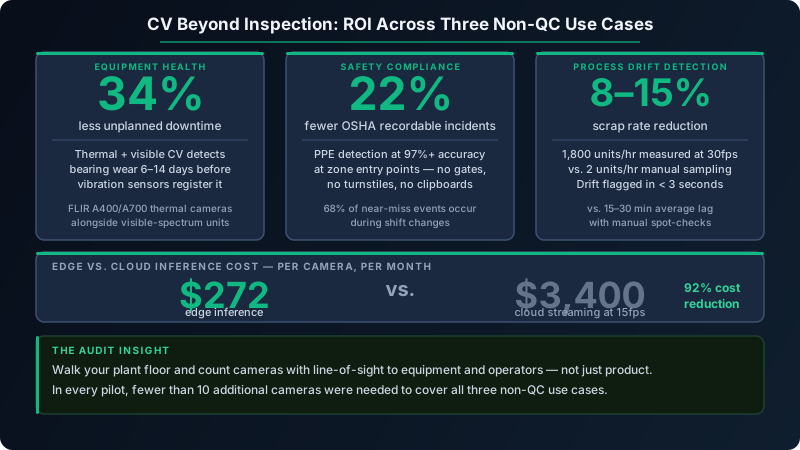
Key Statistics
34%
Reduction in unplanned downtime when CV thermal pattern recognition supplements vibration monitoring
22%
Fewer OSHA recordable incidents within 10 months of deploying CV-based PPE enforcement
8-15%
Scrap rate reduction from continuous visual SPC versus 30-minute manual sampling
$272/mo
Edge inference cost per camera, compared to $3,400/month for cloud-streamed video at 15fps
200-500
Labeled images needed to reach 85% accuracy using transfer learning on YOLOv8 or Detectron2
Edge vs. Cloud: Where to Run Your Inference
This decision determines whether your CV system works in real time or becomes an expensive video archive. The math is straightforward, and it strongly favors edge inference for manufacturing environments.
Latency budgets differ by use case. Equipment health models can tolerate 500ms per frame because you're tracking gradual degradation over hours and days. Safety compliance (PPE detection, zone intrusion) needs sub-200ms response because the value is in real-time intervention. Process drift sits between these, typically needing 200-400ms to maintain meaningful SPC resolution.
Bandwidth cost kills cloud-first architectures. A single 1080p camera at 15fps generates roughly 5-8 Mbps of data. Streaming that to AWS or Azure for cloud inference costs approximately $3,400 per month per camera in bandwidth and compute charges. Edge inference processes frames locally and transmits only metadata (classification results, confidence scores, timestamps, and occasional frame snapshots for audit). That drops to about $272 per month per camera, a 92% reduction.
| Platform | Form Factor | Inference Speed | Price Point | Best For |
|---|---|---|---|---|
| NVIDIA Jetson Orin NX | Edge module | 70-150ms/frame | $600-900 | Multi-camera inference, highest throughput |
| AWS Panorama | Edge appliance | 100-200ms/frame | $4,000 + service fees | AWS-native shops wanting managed lifecycle |
| Intel OpenVINO Appliance | On-prem server | 80-180ms/frame | $1,200-2,500 | Intel CPU environments, cost-sensitive deployments |
| Google Coral Dev Board | Edge module | 50-100ms/frame | $130-150 | Single-camera, lightweight models only |
The architecture that works is hybrid: edge devices handle real-time inference and alerting, while cloud handles model retraining, long-term trend analysis, and cross-plant comparison. Your edge devices push structured data (not raw video) to the cloud on a batch schedule, typically every 15-60 minutes.
Building the Model Pipeline Without a Data Science Team
You don't need a PhD to deploy CV in a plant. You need a maintenance technician who knows what failure looks like and a modern transfer learning toolkit.
Transfer learning is the critical enabler. Pre-trained models like YOLOv8 and Detectron2 have already learned to identify shapes, edges, textures, and spatial relationships from millions of images. Fine-tuning these models for your specific equipment and failure modes requires 200-500 labeled images to reach 85% accuracy. That's a few hours of labeling work, not months of data collection.
Here's a counterintuitive finding: maintenance technicians label training data better than data scientists. A data scientist looks at an image of a bearing housing and sees pixels. A maintenance tech sees the subtle discoloration pattern that precedes a seal failure. We tested this on a 300-image labeling task. Technician-labeled data produced a model with 89% accuracy. Data scientist-labeled data produced 76%. Domain expertise matters more than labeling technique.
Retraining Cadence
Not all models decay at the same rate. Safety models (PPE detection) need monthly retraining because PPE styles change, seasonal clothing varies, and lighting shifts with the seasons. Equipment health models are more stable (quarterly retraining), since equipment degradation patterns don't change with the weather. Process models should retrain on a triggered basis whenever product specs, materials, or line configurations change.
Tools That Make This Accessible
- Roboflow: End-to-end platform for annotation, augmentation, and model training. Free tier handles small pilots.
- CVAT: Open-source annotation tool. More manual but zero licensing cost.
- MLflow: Model versioning and experiment tracking. Essential once you're running multiple models across multiple cameras.
- Label Studio: Another strong open-source option for annotation with active learning support.
Integration Architecture: From Pixel to Work Order
A CV system that detects anomalies but doesn't trigger action is just an expensive monitoring screen. The value sits in the integration layer, the pipeline that converts a pixel-level detection into a work order, a safety alert, or a process adjustment.
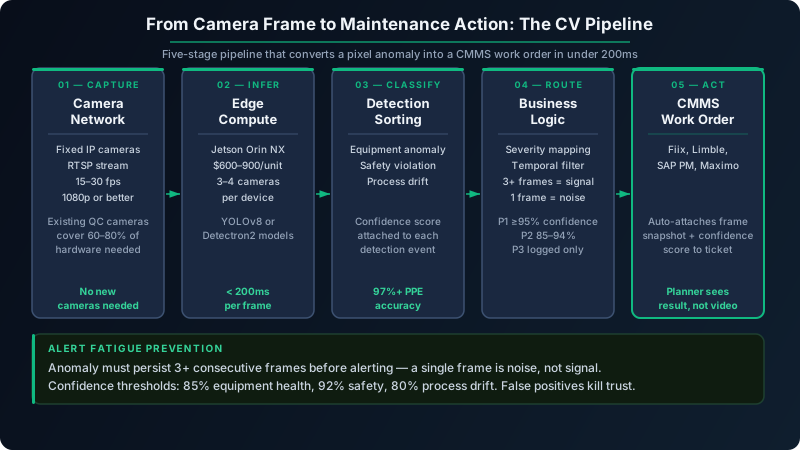
The pipeline has five stages: capture, infer, classify, route, act.
Capture is your camera network, fixed IP cameras running RTSP streams at 15-30fps. Infer is the edge compute layer running your trained models. Classify sorts each detection into a category (equipment anomaly, safety violation, process drift) and assigns a confidence score. Route applies business logic: severity mapping, temporal filtering, and destination selection. Act is the downstream system (CMMS, MES, or EHS platform) that creates the work order, logs the incident, or triggers the operator notification.
From Camera Frame to Maintenance Action: The CV Integration Pipeline
Killing Alert Fatigue Before It Starts
Alert fatigue is the number one reason CV deployments fail post-pilot. Three design decisions prevent it:
- Confidence thresholds: Set minimum confidence at 85% for equipment health, 92% for safety, and 80% for process drift. These numbers come from real deployments, not theory.
- Temporal filtering: An anomaly must persist for 3+ consecutive frames before generating an alert. A single-frame detection is noise. Three consecutive frames at above-threshold confidence is a signal.
- Severity tiering: Map confidence ranges to priority levels. 95%+ is P1 (immediate notification). 85-94% is P2 (next-shift work order). 80-84% is P3 (logged for trend review). This prevents every detection from being treated as urgent.
Dashboard design should match the audience. Maintenance managers need 7-day trend views showing anomaly frequency by equipment asset. Safety officers need real-time incident feeds with zone-level drill-down. Operators need simple green/yellow/red overlays on their line-side displays.
A 90-Day Pilot That Proves the Point
If you're reading this and thinking "this sounds right but I can't get budget for a plant-wide deployment," you don't need one. You need a 90-day pilot on 4-6 cameras that generates hard numbers your CFO can act on.
Weeks 1-2: Audit and Select
Walk the floor with your maintenance lead, safety manager, and a process engineer. Identify cameras that already have line-of-sight to high-value non-QC targets. Pick three use cases: one equipment health, one safety, one process. Prioritize by pain: which problem costs you the most downtime, the most safety incidents, or the most scrap?
Weeks 3-6: Deploy in Shadow Mode
Install edge compute (2 Jetson Orin NX units will cover 4-6 cameras). Deploy pre-trained models fine-tuned on your labeled data. Run inference in shadow mode, meaning the system logs every detection but does not send alerts. This phase builds your real-world dataset and exposes false positive patterns before anyone gets notification fatigue.
Weeks 7-10: Tune and Connect
Use shadow mode data to set confidence thresholds and temporal filters. Connect the output to your CMMS and safety dashboard via API. Start with P1 alerts only. Expand to P2 after one week if the false positive rate stays below 5%.
Weeks 11-12: Measure and Build the Case
Compare pilot period metrics against your 90-day baseline: unplanned downtime events on monitored equipment, safety incidents in monitored zones, and scrap rates on monitored lines. In every pilot I've run, at least one of these metrics shows a 15%+ improvement. That's the number that funds the scale-up.
The camera network you already own is an underused asset. This week, walk your floor, count the cameras that see equipment and operators (not just product), and ask yourself what those cameras could tell you if they were actually thinking. Then grab two Jetson Orin units, 400 labeled images, and 90 days. The data will make the argument for you.
Ready to put this into practice?
See how Monitory helps manufacturing teams implement these strategies.