Predictive maintenance was supposed to be the game-changer. Instead of reactive firefighting or over-scheduled routines, we’d let data warn us before anything breaks. But for many teams, it doesn’t work. AI models make vague predictions. Alerts come too late, or not at all. You’re still guessing, still firefighting, still explaining preventable failures. Why?
The problem isn’t the promise. It’s the data.
Predictive maintenance only works when your data is clean, structured, and mapped to real outcomes. Without that, your AI is blind. Let’s break down why predictive maintenance fails, and what happens when you finally get it right.
Most predictive maintenance programs fail not because of bad algorithms, but because of bad inputs. Here are the 8 data mistakes that derail AI-based maintenance:
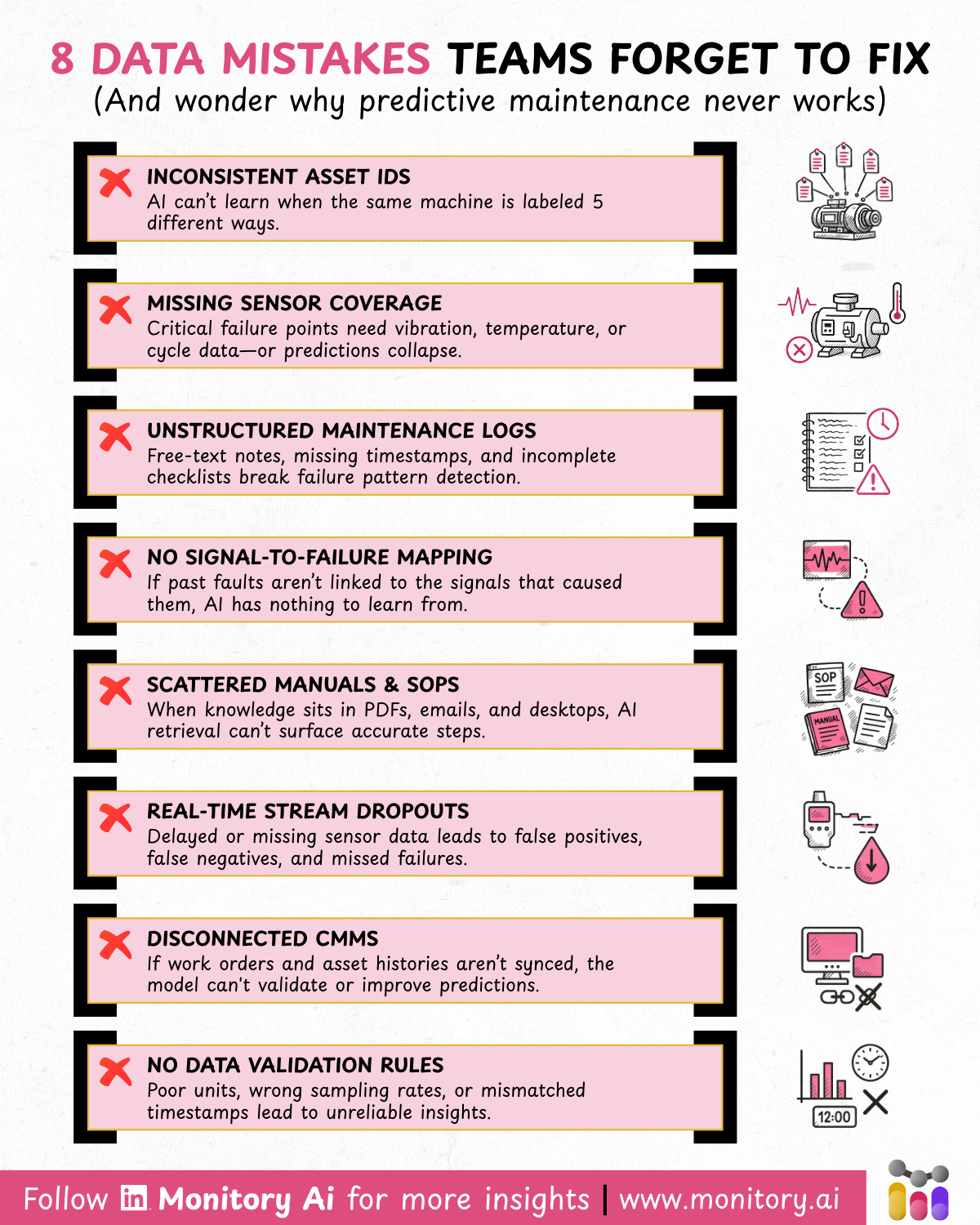
AI can’t learn when the same machine is labeled five different ways. One team calls it "Pump-23," another says "Line2-PM23," and a third just logs "Main Pump." That confusion breaks the model’s memory. Predictive maintenance depends on consistent labeling to tie performance to failure outcomes.
Your biggest risks don’t always come with sensors attached. If vibration, temperature, pressure, or current data is missing, predictive models have nothing to learn from. It’s like trying to forecast the weather with no thermometer.
Free-text notes, missing timestamps, and half-filled checklists are poison to predictive maintenance. AI needs structure: what failed, when, and under what conditions. If logs are vague or inconsistent, the system can’t detect patterns or learn from past failures.
When a bearing fails, what changed beforehand? If you haven’t tagged the lead-up conditions, like increased vibration or rising heat, your AI has no link between signal and failure. Predictive maintenance becomes guesswork.
Crucial knowledge is often trapped in PDFs, inboxes, and personal drives. If AI can’t retrieve standardized procedures or recommended actions, it can’t help crews respond intelligently. Predictive maintenance needs centralized, structured documentation to close the loop.
Sensor data that lags, glitches, or drops out ruins real-time prediction. Delayed inputs lead to false positives, missed failures, and mistrust in the system. Predictive maintenance is only as reliable as your data stream.
If your work orders and asset history live in a different system from your sensors, nothing lines up. Predictive insights can’t validate against past actions. Worse, you can’t train models on resolved issues. Integration is non-negotiable.
If units are inconsistent (Fahrenheit vs. Celsius), sample rates change midstream, or timestamps don’t sync, your AI model gets garbage input. Predictive maintenance collapses when no one notices these invisible mismatches.
Now let’s flip the script. When your data pipeline is solid, predictive maintenance stops being a buzzword and becomes your factory’s superpower. Here are 14 ways predictive maintenance works when powered by AI:
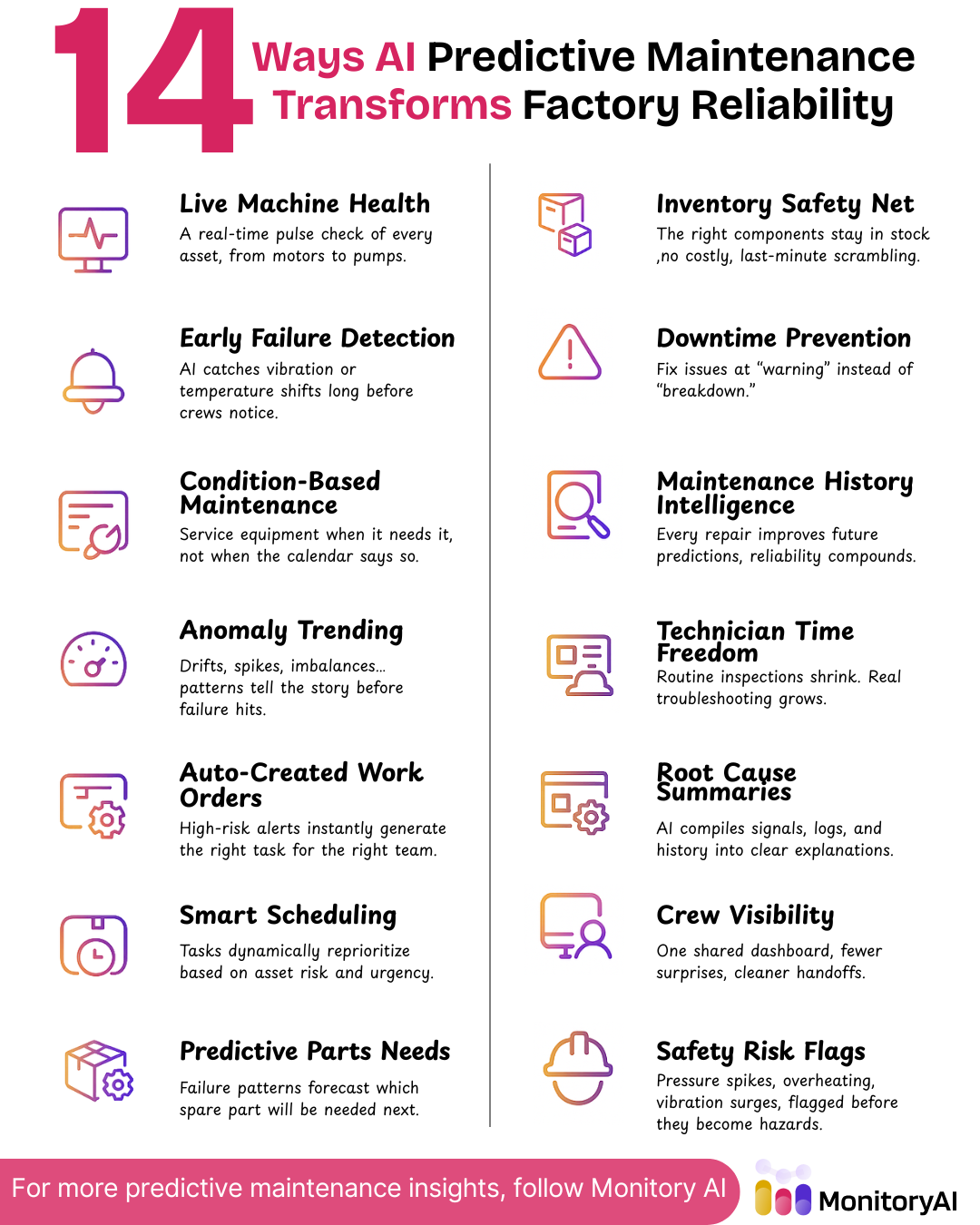
You get a real-time pulse of every asset. Motors, pumps, chillers, if it runs, you can watch its health live. Predictive maintenance means seeing problems as they start, not after they cascade.
Before crews even notice an odd noise or extra heat, AI flags micro-shifts. You get alerts before breakdowns happen. Predictive maintenance lets you stay ahead of failures, not react after damage is done.
Stop following the calendar. Predictive maintenance uses real data to tell you when service is actually needed. That means less wasted time and fewer surprise failures.
Spikes, drifts, imbalances, or rising averages all become visible. AI watches the small changes that lead to big problems. Predictive maintenance becomes a storyline, not just a snapshot.
When the system detects a real issue, it instantly generates the right task for the right asset, to the right team. Predictive maintenance becomes actionable, not just informative.
Based on urgency and asset risk, AI adjusts your work plan. High-risk tasks rise in priority. Low-risk ones wait. Predictive maintenance turns your backlog into a living triage list.
You know which part will fail next, and you stock it before it’s urgent. Predictive maintenance uses patterns to forecast demand and reduce costly delays.
No more last-minute scrambles or overnight shipping. Predictive maintenance ties alerts to inventory, keeping key components in stock and costs down.
Warnings don’t turn into shutdowns. Predictive maintenance gives you time to act, so a flag doesn’t become a failure.
Every resolved issue teaches the system. Predictive maintenance compounds value over time. Each repair trains your model, making future predictions sharper.
When routine checks drop, troubleshooting grows. Techs spend less time inspecting and more time fixing. Predictive maintenance frees up expert time.
The system connects logs, events, and signals into clear narratives. Predictive maintenance becomes a tool for learning, not just alerting.
Dashboards let everyone see what’s happening. Handoffs get cleaner, surprises disappear. Predictive maintenance builds trust across the floor.
Pressure surges, overheating, vibration spikes, predictive maintenance highlights safety risks before they become hazards.
The truth is: AI alone doesn’t fix predictive maintenance. Clean, structured, integrated data does. That’s where Monitory AI comes in.
Monitory fixes the foundation:
Predictive maintenance starts working when data stops breaking. Monitory makes that happen.
If predictive maintenance has failed you, you’re not alone. But the fix isn’t new tools, it’s better visibility.
Monitory AI helps your data talk, your machines speak up, and your team act before failure strikes. Want to stop guessing and start predicting?
Let’s get your predictive maintenance working.