When a critical machine goes down in the middle of a production run, everything stops. Orders are delayed. Labor is wasted. Costs spiral. That’s the real pain behind poor maintenance, and it’s what separates reactive operations from truly efficient ones.
Maintenance isn’t just a technical task. It directly impacts uptime, operational costs, and production quality. It’s a business lever. And in 2025, the companies winning on uptime, cost, and asset longevity aren’t doing more maintenance, they’re doing smarter maintenance.
In this post, we break down the types of maintenance you need to know, the KPIs that matter, and how AI-powered platforms like Monitory are redefining what effective maintenance looks like.
Maintenance is the set of activities performed to keep machinery, equipment, or systems running optimally, or to restore them when they break. But not all maintenance is created equal. The real difference is in when and why the work is done.
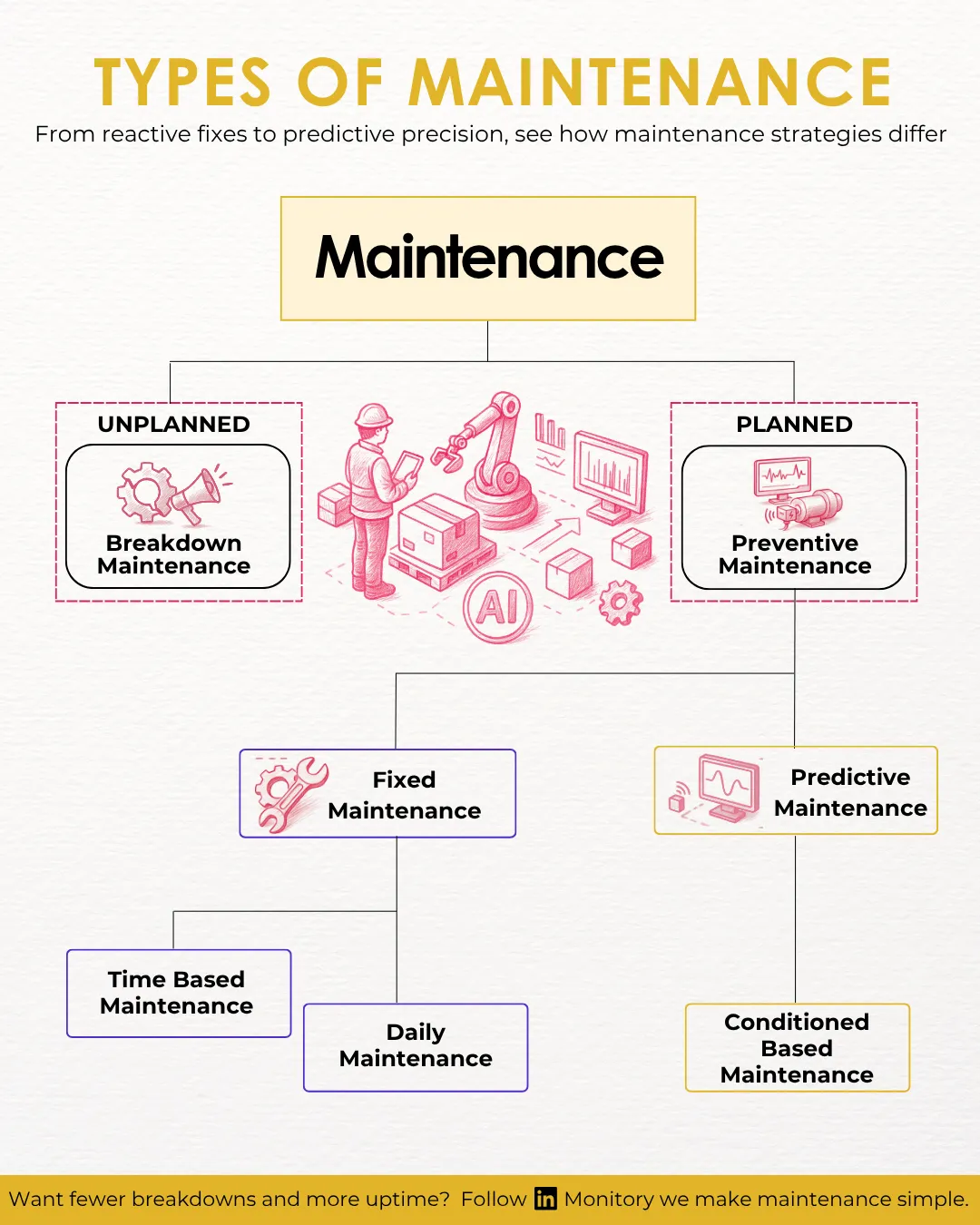
Maintenance falls into two big categories: unplanned and planned. Think of it like fire-fighting vs. fire prevention.
This is the "fix it when it breaks" strategy. Also known as breakdown maintenance, this is what happens when there’s no schedule or prediction, just emergency repairs.
Breakdown maintenance might be unavoidable sometimes, but if it's your go-to strategy, you're burning money.
Planned maintenance is scheduled, proactive, and designed to reduce the likelihood of unexpected failure. It breaks down into three major strategies:
This is scheduled maintenance based on time or usage. It's routine. It's manual. It's what most companies use to "play it safe."
Predictive maintenance uses data from sensors like vibration monitors, thermal cameras, and cycle counters to anticipate when equipment is likely to fail, temperature, vibration, cycle count, etc., to determine when a failure is likely to happen. Instead of checking a machine every month, you check it when the data says it’s nearing risk.
A subset of predictive maintenance, CBM involves real-time monitoring to trigger maintenance only when specific indicators fall out of range.
This is where platforms like Monitory shine: by automating CBM with AI, you only service what needs attention, reducing downtime and unnecessary work.
Planned maintenance often follows a fixed schedule, with two common approaches:
Scheduled after a set amount of time daily, weekly, monthly.
Use case: Lubricating parts every 30 days, regardless of wear.
A type of TBM that focuses on daily visual checks or light service tasks.
Use case: Checking coolant levels, inspecting belts at shift changes.
While fixed schedules are better than nothing, they can still waste resources by servicing equipment that doesn’t actually need it yet.
If TBM is like changing your oil every 3,000 miles, predictive maintenance is like a smart dashboard telling you your oil’s still good, or dangerously low.
Using machine learning, sensors, and historical data, predictive strategies reduce the cost and inefficiency of scheduled routines. More importantly, they let you act before failure, not after.
This is the future of maintenance, and Monitory is building it now.
CBM expands on data-driven strategies by offering condition-specific responses that adapt as issues arise. Instead of analyzing past data to predict failures, CBM uses live operational data to determine the exact moment maintenance is needed.
You’re not just guessing smart, you’re responding in real time.
Example: If vibration on a motor exceeds safe thresholds, an automatic alert triggers inspection or service before a breakdown occurs.
It’s not just about doing the work, it’s about tracking whether it’s working. Here are the KPIs that tell the real story:
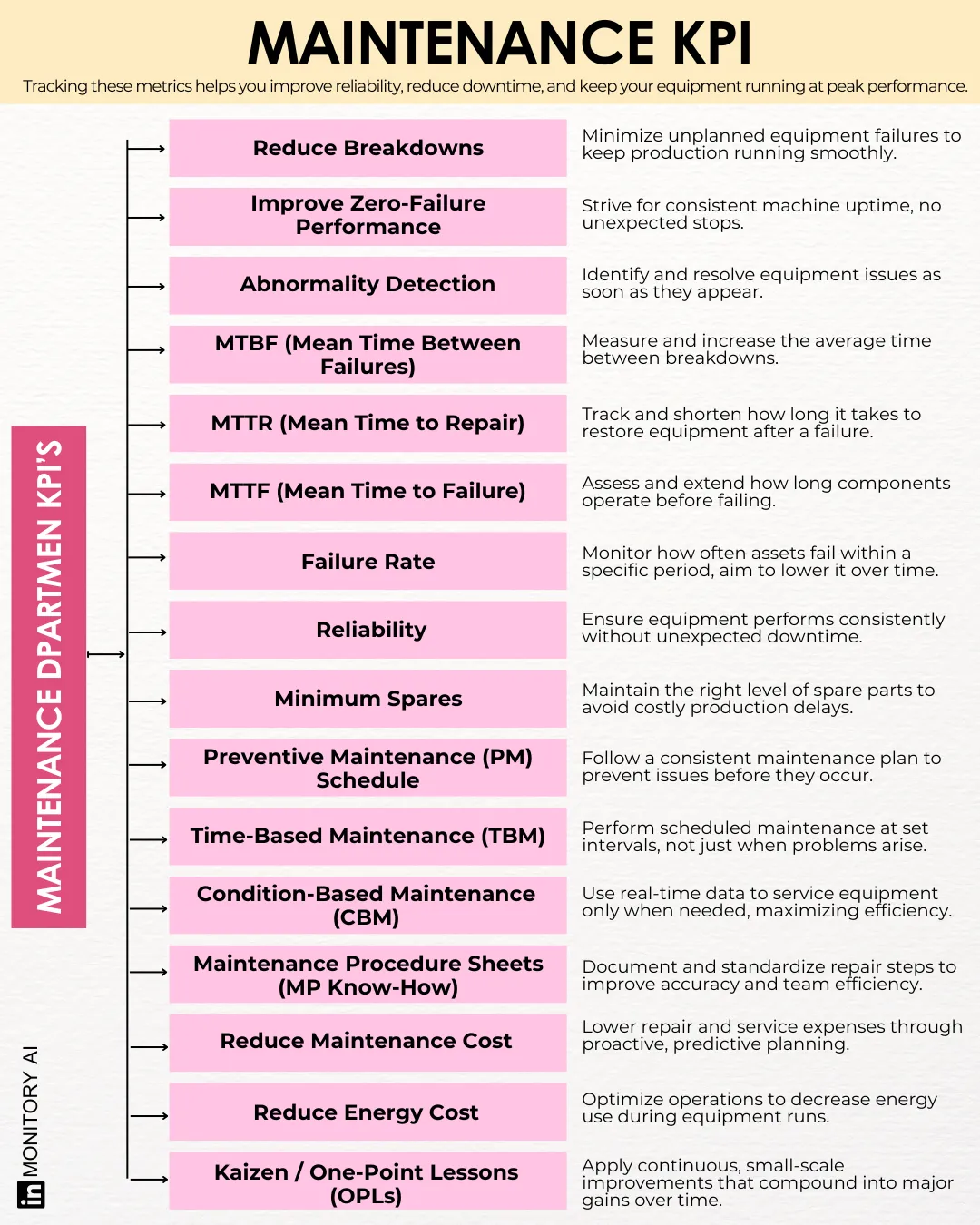
Fewer unplanned stops = higher efficiency. This is the primary success metric for any smart maintenance system.
This KPI tracks how consistently your equipment runs without unexpected interruptions. It’s the difference between surviving and scaling.
Measures reliability. A higher MTBF = longer periods of uptime.
Measures responsiveness. How fast do you recover from failure?
Measures lifespan. Useful for planning part replacements or upgrades.
Tracks how often specific components fail within a given time frame. This helps identify weak spots.
This all-encompassing KPI reflects overall equipment performance and predictability.
Are PM tasks being completed on time and as planned?
How often do you catch problems before they turn into downtime?
Tracking minimum spares ensures you're not stuck waiting on parts when equipment goes down.
Standardized documentation speeds up repairs and reduces human error.
Most maintenance teams are buried in checklists, spreadsheets, and "maybe it's time to fix it" guesses.
Monitory removes the guesswork. By integrating AI-powered monitoring, predictive analytics, and real-time alerting, Monitory gives operations leaders full visibility, and control, over asset health.
Whether you’re running one plant or five, Monitory turns maintenance from a cost center into a performance engine.
In an age of shrinking margins and rising pressure on uptime, companies can’t afford to rely on guesswork anymore. Reactive fixes cost time, labor, and reputation. Scheduled maintenance helps, but it’s blunt and expensive.
The companies pulling ahead? They’re using AI and real-time data to service only what needs servicing, and proving it with better KPIs.
If you want to reduce breakdowns, cut costs, and make your maintenance team look like heroes, it’s time to upgrade your strategy.
Unexpected failures aren't just technical problems. They're business problems. And solving them starts with better maintenance strategy.
Follow Monitory on LinkedIn to see how manufacturers are boosting uptime, slashing service costs, and scaling smarter, one predictive insight at a time.
Because when your machines run better, your business runs better.